
 English

On March 15 (local time), the Optical Fiber Communication Conference and Exposition (OFC 2026)—the world's most influential academic and industrial event in optical communications—officially kicked off in the United States. At the conference, YOFC showcased its latest cutting-edge advances optical communication technologies to the global industry.
Luo Jie, Technical Director of YOFC and Director of the State Key Laboratory of Optical Fibre and Cable Manufacturing Technology (YOFC-SKL), was invited to attend the seminar "Anti-Resonant Hollow Core Fibre: The Hype, The Hope, The Headaches" and delivered a presentation titled "Hollow Core Fibres: From Laboratory Innovations to Commercial Applications".
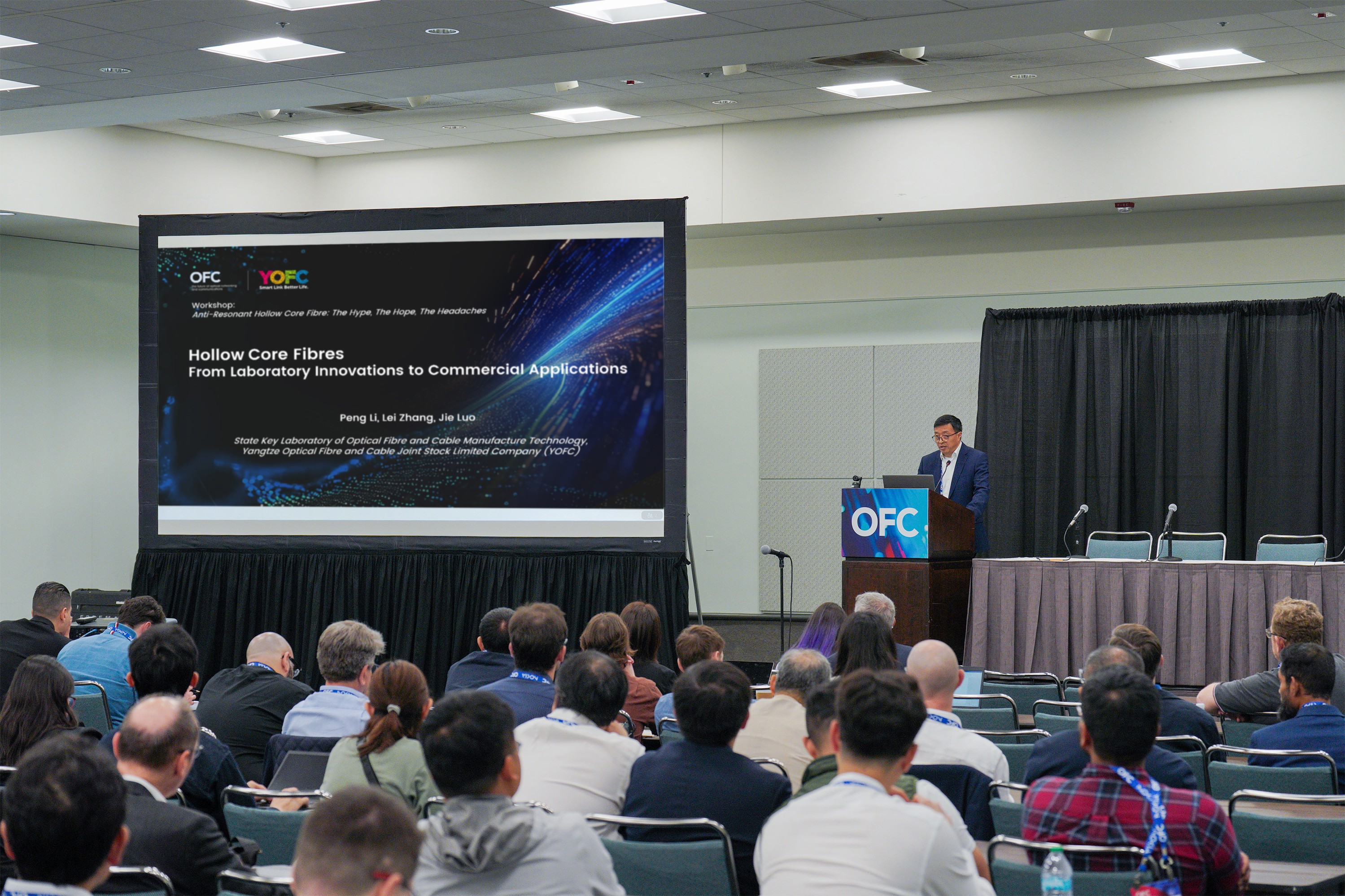
Luo Jie detailed YOFC's technological breakthroughs in structural innovation and large-scale manufacturing of hollow-core fibres. Building on the global optical fibre attenuation record of 0.05 dB/km announced at last year's OFC, YOFC has further reduced attenuation to 0.04 dB/km, demonstrating continuous advancement in hollow‑core fibre technology and its strong commercial potential. He also reported practical advances in hollow-core fibre splicing, adapters between hollow‑core and conventional fibres, OTDR testing for hollow‑core fibres, and the deployment of hollow‑core optical cables in engineering projects. Together, these developments constitute a systematic set of solutions to the challenges faced in the commercial applications of hollow‑core fibres.
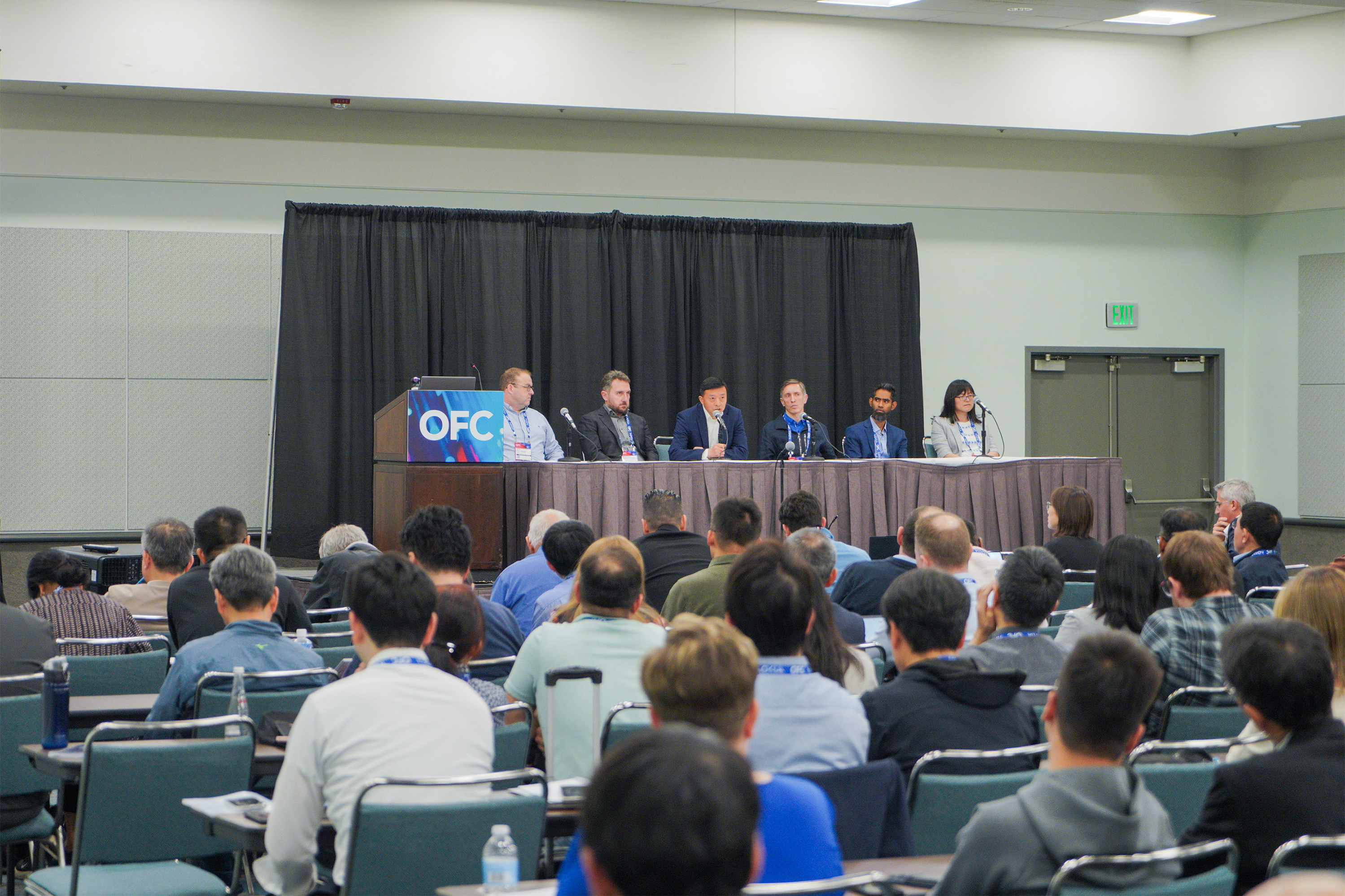
As a key direction for next‑generation optical communication infrastructure, hollow‑core fibre is progressing from laboratory research to industrial application. YOFC leads the technological frontier with continually improving performance metrics and addresses challenges in commercial applications through comprehensive engineering solutions. Looking ahead to the information industry, YOFC, leveraging the YOFC‑SKL, will continue to deepen the integration of technological and industrial innovation, driving critical breakthroughs in hollow-core fibre industrialization and large-scale applications. This will provide a transmission medium with ultra‑low loss, ultra‑low latency and ultra‑high capacity for next‑generation optical networks, and deliver essential support for the upgrade of global digital infrastructure.
-
2026.06.25Bridging Borders, Building Leaders: YOFC Successfully Concludes 2nd GLDP1
-
2026.06.04Thirty-eight Years Dedicated to Optical Fibre, A New Chapter in the AI Era
-
2026.03.19OFC 2026 | YOFC Technical Director Luo Jie Presents "Hollow Core Fibres: From Laboratory Innovations to Commercial Applications"
-
2026.03.19YOFC SmartCarbon Receives International Certifications and Industry Awards
-
2026.03.06YOFC Unveils HollowBand® Hollow-Core Fibre at MWC Barcelona 2026


